Blank Graph Paper 1/4 Inch Squares PDF (Free Printables)
You will see blank graph paper with 1/4 inch squares in almost every single middle and high school mathematics classroom across the country. This specific measurement means you get exactly 4 precise grid squares per inch of paper, giving you the perfect visual scale for plotting complex data.
I built this custom graph generator so you can instantly download and print 1/4 inch grid PDFs for free at home. Math teachers absolutely demand this specific size because it provides enough physical space for you to write clear coordinate numbers and draw thick, visible graph lines.
Using this scale guarantees you can plot geometric shapes without ever crowding the page. Whether you are solving linear equations or sketching basic architectural floor plans, the 1/4 inch square provides the ultimate balance of precision and readability. I highly recommend using this exact size so your homework stays 100% accurate!
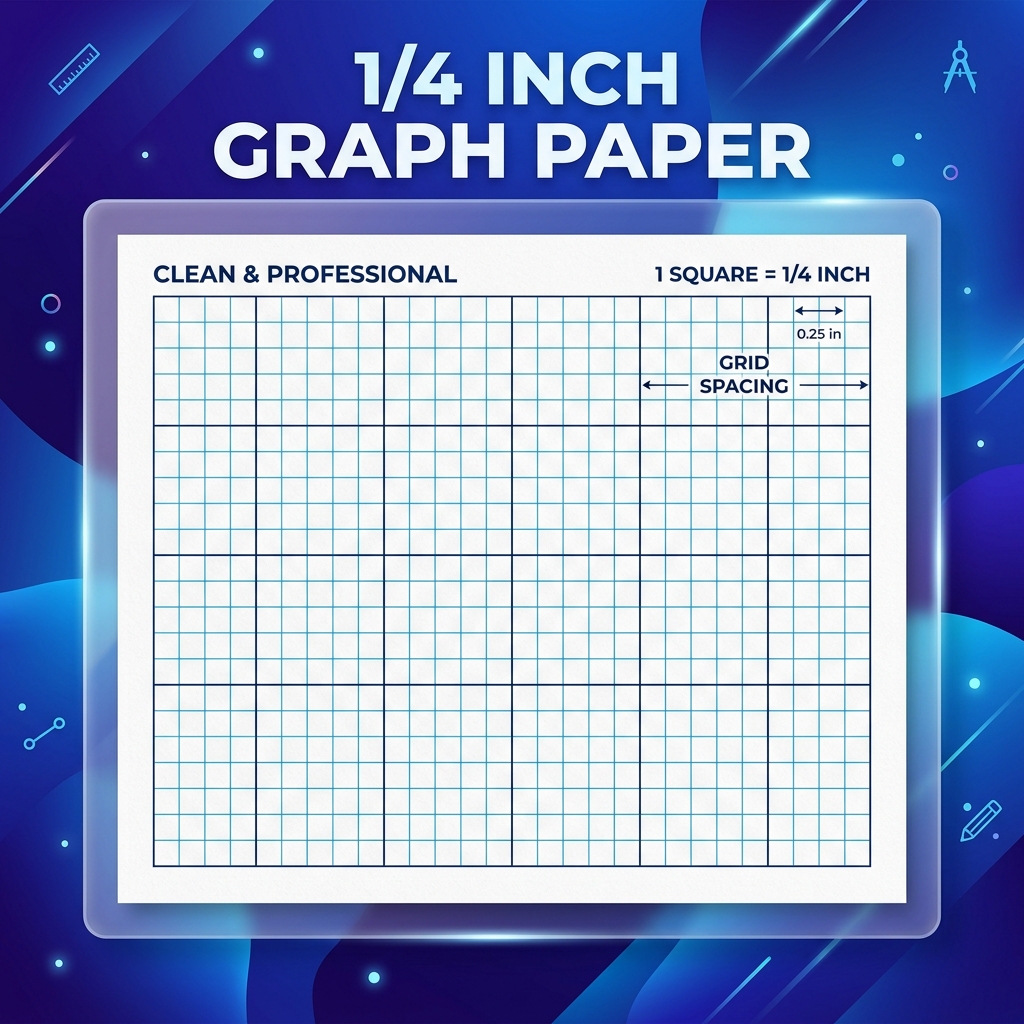
If you have ever taken a high school algebra class, you have definitely seen this exact type of paper. It is literally everywhere. You open any standard math notebook, and boom, you are looking at one-quarter inch squares.
But why this specific size? Why not half an inch? Or a full inch? We are going to break down exactly why the 1/4 inch grid became the gold standard for mathematics, and how you can stop buying expensive notebooks by generating your own PDFs right here on our site.
Table of Contents
- Why Teachers Demand 1/4 Inch Squares
- The Best Subjects for This Grid Size
- How to Avoid Printer Scaling Errors
- Comparing Grid Sizes Side-by-Side
- Generate Your Grid Instantly
- Frequently Asked Questions (FAQs)
- 1. What exactly does 1/4 inch graph paper mean?
- 2. Why do math teachers overwhelmingly prefer quarter-inch grid paper?
- 3. How can I ensure my printer prints the grid at exactly 100% actual size?
Why Teachers Demand 1/4 Inch Squares
When you are plotting linear equations, space is your biggest enemy. If you use a grid with tiny millimeter squares, your pencil lines will overlap. You will not be able to read your own handwriting. It turns into a giant, messy smudge.
On the flip side, if you use a massive one-inch grid, you can only fit maybe ten numbers on the entire page. That is useless for plotting complex data.
The 1/4 inch square fixes both problems perfectly. It offers exactly 4 squares per inch. This gives students enough physical room to write legible numbers on the X and Y axes, while still allowing a massive data range (usually -20 to +20) on a standard A4 or US Letter sheet.
The Best Subjects for This Grid Size
You cannot use one grid for everything. Different subjects demand different visual scales. Here is a breakdown of where this specific quarter-inch size shines:
- 📐 Algebra I & II: Perfect for graphing parabolas, linear equations, and finding the slope of a line.
- 📐 Basic Geometry: Ideal for drawing 2D shapes, calculating area, and reflecting polygons across an axis.
- 📐 Middle School Science: Great for plotting basic bar charts and line graphs for lab experiments.
- 📐 DIY Floor Plans: Architects and hobbyists use this scale (where 1/4 inch equals 1 foot) to sketch room layouts.
If you are jumping into advanced engineering or college calculus, you will probably need to switch to a 5-millimeter grid. But for 90% of standard schoolwork, this is the only size you need.
How to Avoid Printer Scaling Errors
Here is a massive headache you want to avoid. You download a beautiful PDF grid. You hit print. But when the paper comes out, the squares are not actually 1/4 inch. They are slightly smaller. What happened?
Your printer software lied to you. By default, most printers have a setting turned on called "Fit to Page" or "Scale to Fit". This shrinks the PDF by about 5% so it doesn't get cut off by the printer margins.
If you need your squares to be mathematically precise, you must turn this setting off. Always select "Actual Size" or "Scale: 100%" in your printer dialogue box before you print. This guarantees your ruler will match the grid perfectly.
Comparing Grid Sizes Side-by-Side
If you are still unsure if you need the quarter-inch size, take a look at this quick comparison table. It will help you make the right choice before you generate your file.
| Grid Size | Squares Per Inch | Primary Use Case |
|---|---|---|
| 1/4 Inch | 4 Squares | High School Algebra & Standard Math |
| 1/8 Inch | 8 Squares | Detailed Technical Drawing |
| 5 Millimeter | ~5 Squares | University Science & Engineering |
Generate Your Grid Instantly
Are you ready to print? Do not waste money buying expensive grid notebooks from the store. You can generate unlimited sheets for free using our Custom Graph Paper Generator.
Just click the link, select "1/4 Inch" from the grid spacing dropdown, and hit the download button. You will instantly receive a crisp, high-resolution PDF that you can print as many times as you want. You can even change the line colors if you prefer blue or gray grids instead of harsh black lines.
Frequently Asked Questions (FAQs)
1. What exactly does 1/4 inch graph paper mean?
A blank graph paper 1/4 inch squares PDF features a grid where every single square measures exactly 0.25 inches on all sides. This standard measurement guarantees you get exactly 4 squares per inch math paper on your printed page.
2. Why do math teachers overwhelmingly prefer quarter-inch grid paper?
Math teachers demand quarter inch grid paper printable sheets because they provide the ultimate visual scale. The squares are large enough for students to write clear coordinate numbers, but small enough to graph massive linear equations on a single page.
3. How can I ensure my printer prints the grid at exactly 100% actual size?
To print a high school algebra graph paper PDF perfectly, you must open your printer dialogue settings. You must uncheck the default "Fit to Page" option and explicitly select "Actual Size" or "Scale: 100%" to maintain mathematical accuracy.

💬 Discussion
0 Comments