Isometric Graph Paper vs Standard Grid Paper: Which Do You Need?
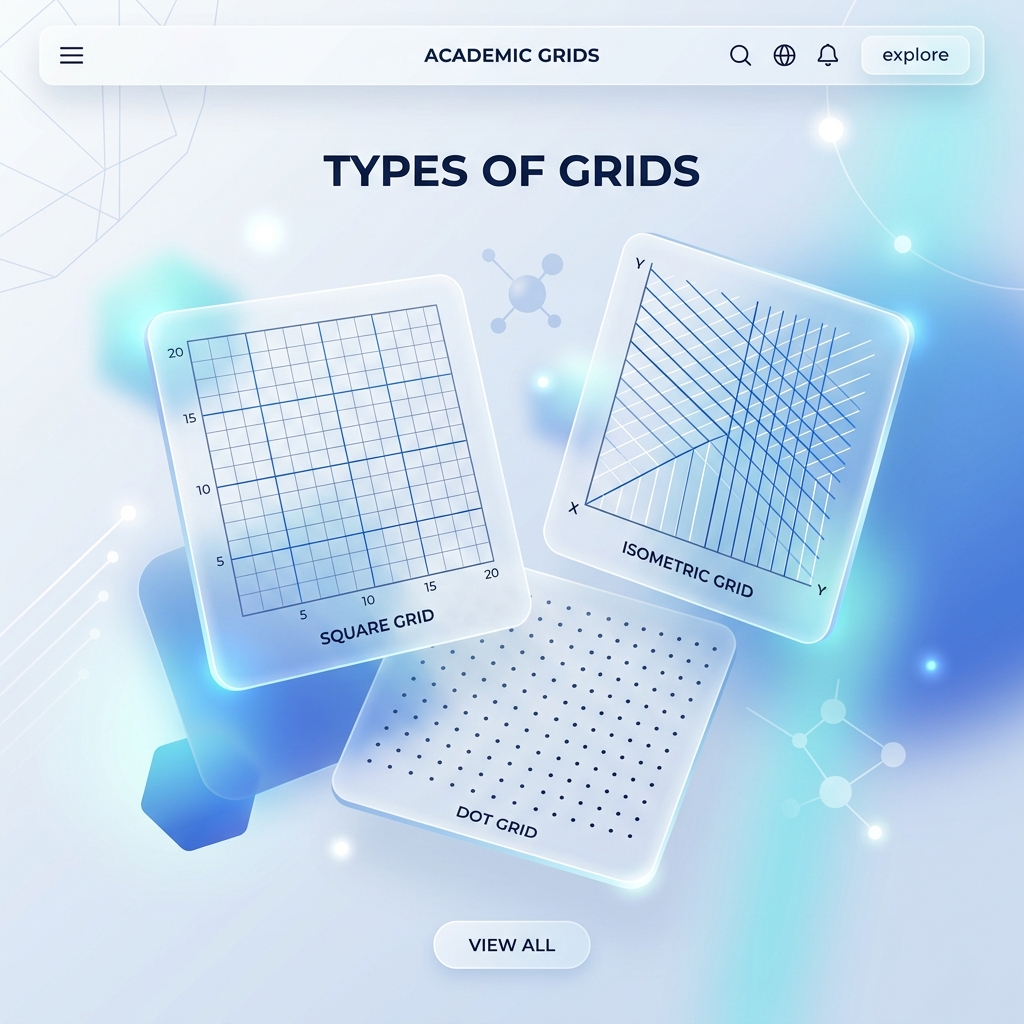
The main difference between isometric graph paper and standard grid paper completely comes down to their geometric structure. Standard grid paper features a flat 2D Cartesian plane made of perfect squares meeting at exactly 90-degree angles. I use this standard grid exclusively for algebra and plotting coordinates.
Isometric graph paper, on the other hand, consists of an interconnected grid of small equilateral triangles that meet at precise 60-degree angles. This unique triangular structure creates a built-in optical illusion of depth. You will immediately notice how it forces your drawings into perspective.
This structure allows you to easily sketch accurate 3-dimensional (3D) objects on a completely flat piece of paper. You never have to worry about complex vanishing points or perspective calculations. I highly recommend generating a free isometric PDF today if you want to practice your drafting skills!
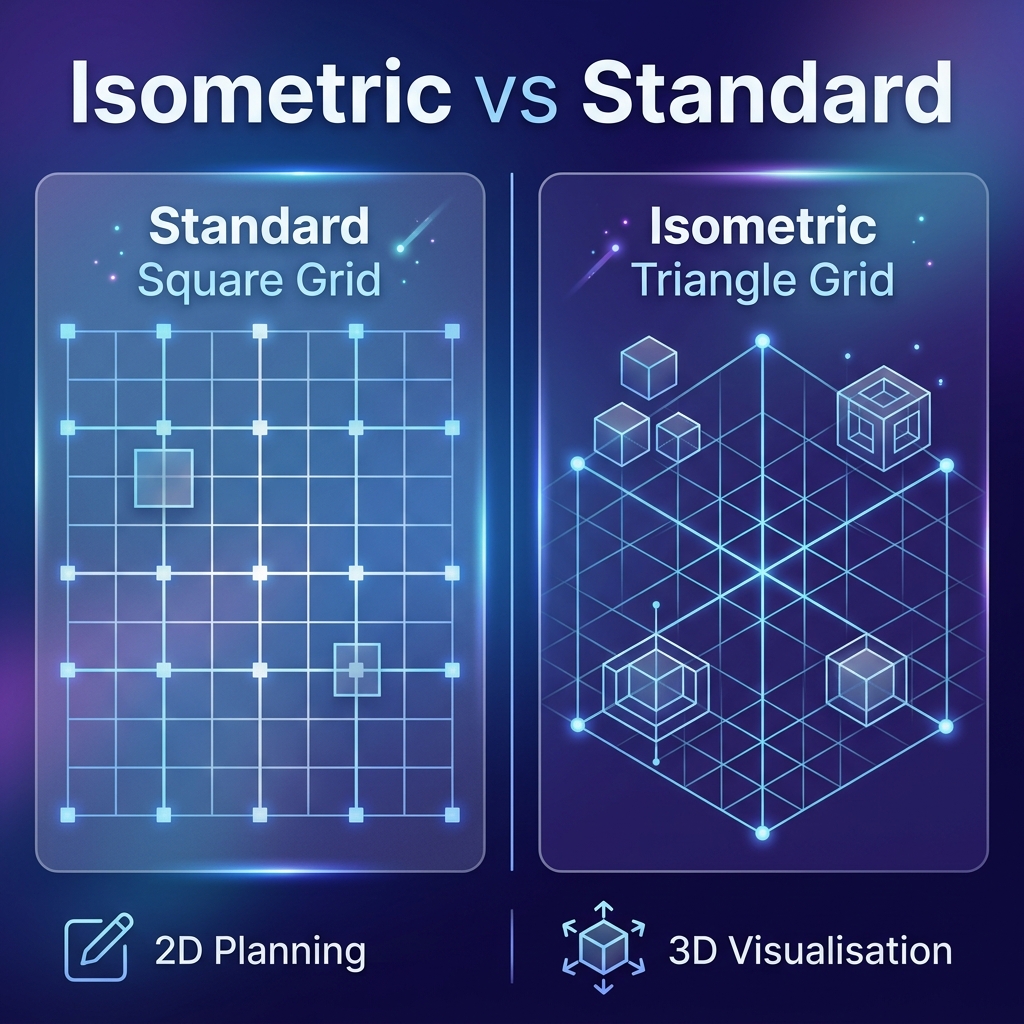
If you walk into any high school math class, you will see standard square grid paper on every desk. It is the king of the classroom. But if you walk into an engineering lab or an architecture studio, you will see something completely different. You will see paper covered in tiny triangles.
That is isometric graph paper. At first glance, it looks incredibly confusing. Your eyes try to make sense of the overlapping diagonal lines. But once you understand how to use it, it feels like a total superpower for drawing 3D shapes.
Table of Contents
- Understanding the Standard Cartesian Grid
- The Magic of the Isometric Triangular Grid
- Side-by-Side Comparison: Which One Should You Use?
- How to Print Both Types Instantly
- Frequently Asked Questions (FAQs)
- 1. What is isometric graph paper primarily used for?
- 2. What is the exact geometric difference between standard and isometric grids?
- 3. How do you easily draw a 3D cube using an isometric triangular grid?
Understanding the Standard Cartesian Grid
Standard grid paper is flat. It lives completely in the second dimension. Every horizontal line crosses a vertical line at a perfect 90-degree angle, creating endless rows of uniform squares.
This layout is strictly tied to the Cartesian coordinate system (the X and Y axes). It is fundamentally designed for measuring two-dimensional space. If you want to plot a linear equation, find the area of a rectangle, or map out a simple floor plan, standard grid paper is flawless.
But what happens if you try to draw a 3D cube on standard grid paper? It usually looks terrible. You have to awkwardly draw diagonal lines through the squares, trying to guess the correct angle of perspective. The final drawing often looks distorted or completely flat.
The Magic of the Isometric Triangular Grid
This is exactly where isometric paper steps in to save the day. The word "isometric" actually comes from Greek, simply meaning "equal measure". Instead of boring squares, you get equilateral triangles that meet at precise 60-degree angles. I always use these 3 simple rules to read the lines:
- Vertical Lines: These stay straight up and down, representing 100% of your object's height.
- Left Diagonal Lines: These angle precisely at 30 degrees to represent width.
- Right Diagonal Lines: These angle precisely at 30 degrees to represent depth.
Because the lines are already angled for you, drawing a perfect 3D cube is basically tracing. You do not have to worry about vanishing points or perspective rules. The grid mathematically forces your drawing to look three-dimensional. It is borderline cheating, and professional designers love it.
Side-by-Side Comparison: Which One Should You Use?
Still not sure which PDF to generate? Let's break down the exact use cases for both types of paper.
| Feature | Standard Grid Paper | Isometric Graph Paper |
|---|---|---|
| Grid Shape | Squares (90-degree angles) | Equilateral Triangles (60-degree angles) |
| Dimension Focus | 2D (Width and Height) | 3D (Width, Height, and Depth) |
| Best School Subjects | Algebra, Basic Geometry, Data Plotting | Drafting, Architecture, Engineering |
| Real World Uses | Floor plans, bullet journaling | Product design sketches, 3D pipe layouts |
How to Print Both Types Instantly
You do not need to buy two separate notebooks. If you need standard squares for your math homework today, and isometric triangles for an engineering project tomorrow, you can generate both right here.
Go to our Free PDF Generator Tool. By default, it creates standard Cartesian squares. But if you click on the grid options dropdown, you can switch the style instantly. You can even customize the spacing and line colors before downloading your high-resolution PDF.
Frequently Asked Questions (FAQs)
1. What is isometric graph paper primarily used for?
Architects and engineers use 3D triangular grid paper primarily to sketch accurate three-dimensional models. Because the lines are pre-angled, you can instantly draw perspective without calculating complex vanishing points.
2. What is the exact geometric difference between standard and isometric grids?
Standard Cartesian grid squares intersect at perfect 90-degree angles to map flat 2D space. Conversely, an equilateral triangle drafting paper grid intersects at precise 60-degree angles to mathematically simulate 3D depth on a flat page.
3. How do you easily draw a 3D cube using an isometric triangular grid?
You draw straight vertical lines to represent height, and then trace along the 30-degree diagonal left and right lines to represent depth and width. The architectural 3D sketching paper perfectly aligns your lines into a flawless cube.
💬 Discussion
0 Comments