When you teach negative integers to your students like -4 + 7 or -3 - (-5), mental arithmetic often fails because they cannot picture values below zero. Below, we provide a free printable integer number line and a 3-step classroom walkthrough.
Quick Answer: What is a Printable Number Line with Negative Numbers?
- Zero-Centered Scale: Places
0in the exact middle, with negative integers (-1to-20) extending left and positive integers (+1to+20) extending right at equal 5mm or 1/4-inch ticks. - Visual Integer Operations: Lets you and your students physically hop a pencil right for addition (
+) and left for subtraction (-) to master absolute value. - Instant Classroom Printout: Select Number Line (Negative & Positive) in our free generator above to print 4 strips per A4 sheet at ₹0 cost.
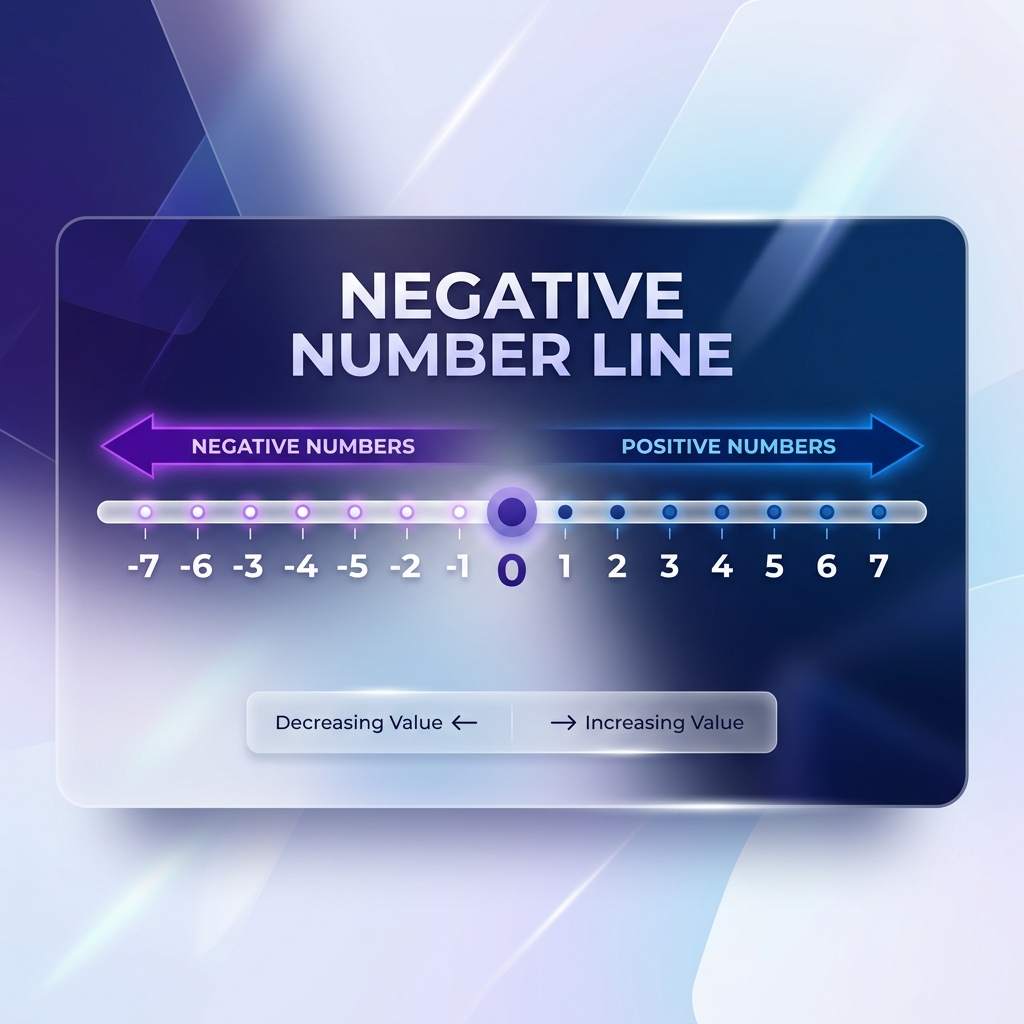
Teaching a 10-year-old about negative numbers for the first time is always tricky. Up to Class 5, numbers only represent physical objects, since you can hold 3 apples, but you cannot hold -3 apples.
That abstract jump creates a common hurdle in Class 6 math. Instead of just writing -4 + 6 = 2 on the board, place a printed number line with negative numbers printable strip right on the student's desk so they can trace the movement physically.
- Step-by-Step: Teaching Integer Addition & Subtraction
- Why Physical Paper Strips Beat Passive Screen Tapping
- Side-by-Side Comparison: Choosing the Right Integer Range
- Common Mistakes Students Make with Negative Signs
- Download Your Printable Number Line PDF Now
- Print 4 Integer Number Line Strips Per Page
- Frequently Asked Questions (FAQs)
Step-by-Step: Teaching Integer Addition & Subtraction
Follow this 3-step classroom method to turn integer rules into visual muscle memory:
- Step 1 - Start with the Thermometer Analogy (-10°C to +40°C): Show students a vertical Celsius scale first because they already understand that 5 degrees below 0°C is -5°C.
- Step 2 - Trace the Pencil Jumps (-4 + 6 = +2): Place the pencil tip on
-4, move 6 ticks to the right for+ 6, and watch the pencil cross zero to land directly on+2. - Step 3 - Master the Double Negative Flip (5 - (-3) = +8): Teach that subtracting a negative reverses direction: starting at
+5, facing left for subtraction, and stepping 3 ticks backward moves you right to+8!
Why Physical Paper Strips Beat Passive Screen Tapping
Gamified math apps are popular in 2026, yet many Class 6 to Class 8 teachers notice that students still confuse signs during written tests.
When an app animates a frog jumping across a screen, your student watches passively. Tracing 10mm or 6.35mm intervals by hand with a pencil engages spatial memory and prepares students for 2D graphing on a 4-quadrant coordinate plane.
Classroom Tip: Print our number line sheets on thick 100 GSM card paper or laminate them with clear tape so students can draw erasable dry-erase marker hops all semester without reprinting.
Side-by-Side Comparison: Choosing the Right Integer Range
You can match your student's grade level and syllabus to the ideal number line scale we have listed for you below:
| Number Range | Tick Spacing on A4 | Target Grade Level | Primary Math Topic |
|---|---|---|---|
| -10 to +10 (20 Units) | 9.0 mm per unit (Horizontal A4) | Classes 5 & 6 | Zero crossing, additive inverse, and basic integers |
| -20 to +20 (40 Units) | 6.35 mm (1/4") or 5 mm | Classes 7 & 8 | Multi-step integer subtraction and absolute value |x| |
| Blank Tick Marks | Custom (5 mm or 10 mm) | Classes 9 & 10 | Rational fractions (-3/4, 5/2), decimals, and inequalities |
For official Indian curriculum exercises on integer operations, check the NCERT Mathematics Textbook Portal alongside our 1/4 inch graph paper and grid paper uses guide.
Common Mistakes Students Make with Negative Signs
Watch where students place their pencil first. In Class 6 tests, the most frequent mistake is counting the starting tick mark as "Hop 1" instead of zero.
To fix this from day one, tell your students to tap the starting integer and say "Zero" before moving their pencil. When we teach you to count the spaces between ticks rather than the lines, your pencil lands cleanly on +2 for -3 + 5.
Another classic trap happens when comparing two negative numbers like -8 and -2. Because 8 is larger than 2 in primary school arithmetic, you will often see students write that -8 > -2.
Pointing to our horizontal strip clears up that confusion in seconds. Any number sitting further to the right on your number line is always greater, which proves visually why -2°C is warmer than -8°C.
Download Your Printable Number Line PDF Now
Open our Main Graph Paper Generator above, select Number Line (Negative & Positive) from the Grid Type dropdown, choose A4 or US Letter, and download your crisp 254 DPI PDF in 5 seconds.
Print 4 Integer Number Line Strips Per Page
Select Number Line (Negative & Positive) in our free 254 DPI generator to print ready-to-cut classroom strips (-10 to +10 or -20 to +20) on A4 or US Letter paper.
Launch Free Graph Paper Generator →Frequently Asked Questions (FAQs)
1. How do you use a printable number line to teach negative numbers?
You can ask your students to place their pencil at the first number and hop right for addition (+) or left for subtraction (-). Crossing 0 visually demonstrates why -4 + 6 lands on +2 without rote memorization.
2. What is the best integer number line range for middle school students?
A -10 to +10 scale works best for introducing negative integers in Class 6, while a -20 to +20 scale on horizontal A4 paper gives Class 7 and Class 8 students enough room for multi-step equations.
3. Can I print blank number lines for fractions and inequalities?
Yes, after you choose Number Line (Negative & Positive) in our free generator, simply uncheck Show Axis Labels (X/Y) to print clean, unnumbered horizontal tick marks so your students can label custom rational fractions like -3/4, -0.5, or √2.